
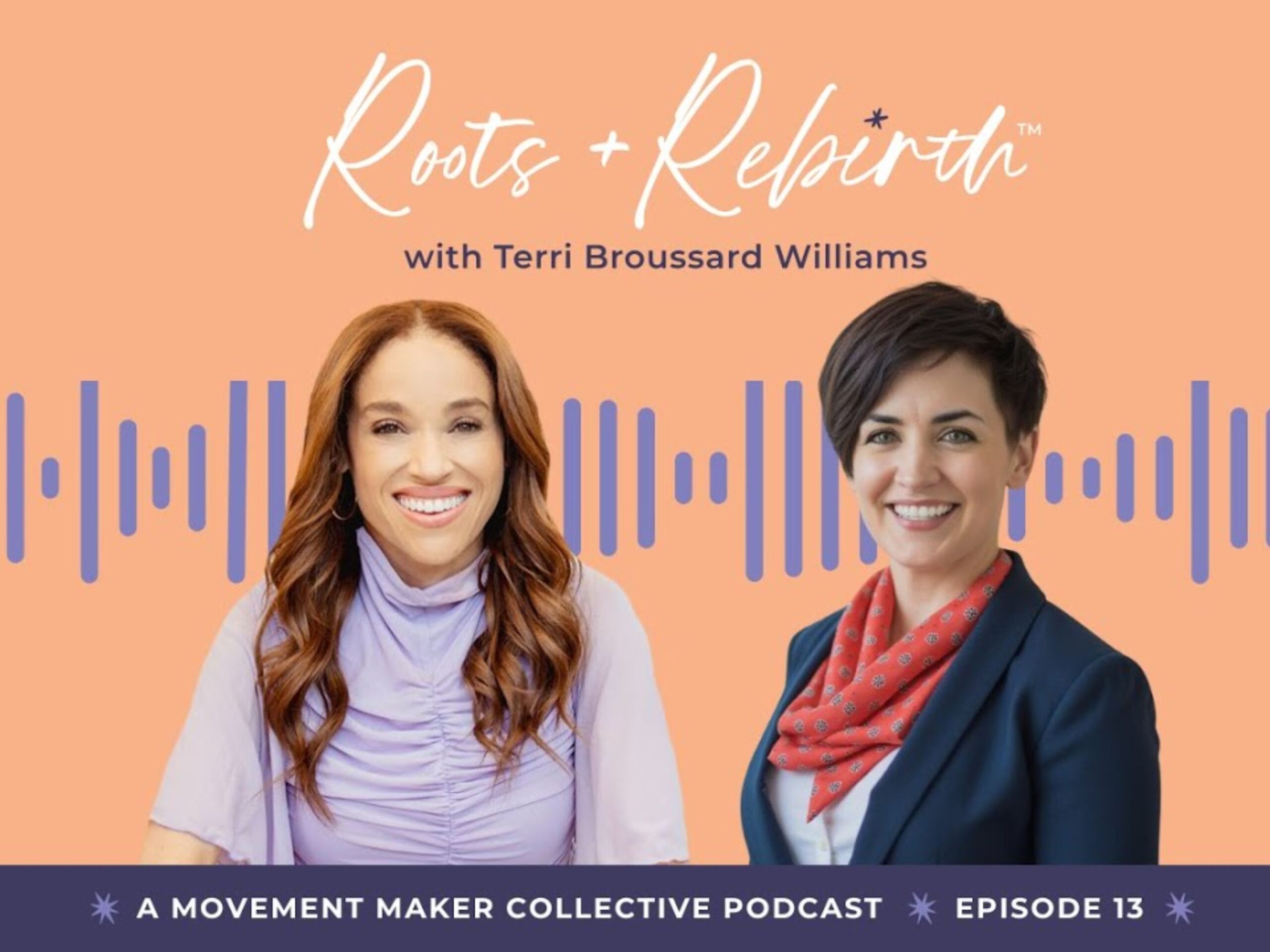
I recently had the pleasure of being featured on the Roots + Rebirth™ podcast, hosted by Terri R. Broussard Williams.
We had an incredibly meaningful conversation about entrepreneurship, resilience, and what it truly means to begin again—both in business and in life.
In this article, you'll find an overview of the key topics we discussed, a link to watch the full conversation, and the complete transcript of our dialogue.
What We Discussed
Our conversation touched on several profound themes around personal and professional transformation:
- The entrepreneurial journey from architecture to building BestSelf Co. - How undiagnosed ADHD led me to create productivity tools for myself, the unexpected success of our Kickstarter campaign ($326K in 34 days), and winning Shopify's "Build a Business" competition twice
- Navigating personal and professional loss - Dealing with divorce, business partner breakups, embezzlement, and the emotional complexity of selling a company I'd built from scratch
- The rebirth: buying back BestSelf Co. - Why I initially sold the business, what changed during my year away, and how buying it back became an opportunity to rebuild with intention, incorporating AI and new efficiencies while focusing on joy and purpose
- Spiritual practices and self-care - The role of breathwork, journaling, and biohacking in maintaining clarity and resilience through transformation
Listen Now
Watch the full conversation below, or click here to watch on YouTube.
Full Transcript
Terri: Welcome to Roots and Rebirth. I’m Terri Broussard Williams. Get ready to hear life-inspiring stories of transformation, resilience, and purpose. Each episode dives deep into the journeys of extraordinary individuals who’ve used their roots, experiences, and challenges to create movements and build businesses for social good. But most importantly, they are focused on living, leading, and leaving joyful legacies. Whether it’s overcoming adversity, embracing spirituality, or leading with authenticity, these conversations will guide you towards living a life full of impact and, hopefully, more joy. Now it’s time to transform your life, rooted in purpose and a rebirth of passion. Let’s get talking.
Terri: Okay, you guys, I always tell you that I want to share my own stories, tips, and tools. And today, I’m going to introduce you to the founder of one of my very favorite tools: my daily journal! We’ll get a picture up so that you can actually see it; there’s some magic that will help make that happen. But this is my very favorite journal, something that I’ve used since I started my blog in 2017. It helped me write Find Your Fire, my book; it helped me sketch my TEDx talk. It is the BestSelf Journal. And today we have its founder, Cathryn, with us to talk about her very own roots and rebirth. Welcome, Cathryn!
Cathryn: Hi! It’s great to be here.
Terri: Yes! We are recording this—we're meeting for the first time—but we’re like down the street. You’re in Austin, Texas.
Cathryn: Yeah, this is a new, cool place to be.
Terri: I feel like so many cool brands are from Austin, but also so many cool thought leaders in the space of mindfulness and spirituality. So I’m not surprised that you found yourself here in Austin from New York City. Tell us how you got here.
Cathryn: So, I got to Austin from New York. I lived in New York for seven years, and I’ve lived in Austin for six years. But I’m actually from Northern Ireland originally. All my family are there still. I went to university in England and Scotland, then I got an internship in architecture—that’s what I used to do. And then, I basically always wanted to live in New York. It was like that whole cliché, "If you make it here, you can make it anywhere." So I was like, "Oh, I have to go." I went to New York when I was 18 and I was like, "I have to come here." And so I moved when I was 22 by myself to be an architect because I got a job. I worked there for a couple of years making like no money, and then I realized I was always entrepreneurial. So that was kind of my first roots and rebirth—leaving architecture to do something else. And then I think in 2018, I just was kind of tired of New York. Being there for seven years, it’s very like you’re "on" all the time. And I was like, "I want to put down roots a little more and have more community," and I just didn’t feel like I could do that in New York. I feel like in New York you’re so busy; even with good friends, you see each other and you’re in catch-up mode all the time, not going deep. And so, yeah, Austin, I kind of just on a whim decided to move.
Terri: That’s so wild! I had no idea you were from overseas, like you grew up overseas. That’s so cool. And of course, now I can hear it in your voice.
Cathryn: Yeah, people tell me that all the time.
Terri: People tell me that I’m from the South—I’m a true Southern belle, so you’ll hear my little twang every now and then. But I love your products. I have your journals, I have your cards… For someone who is not familiar with the BestSelf Co.—because that’s your website—how do you describe it?
Cathryn: I’m terrible at like marketing myself, but in general, I say we create products to help people become their best selves. We started in the productivity space, so it was like, "Okay, here’s how to achieve your goals." I was like undiagnosed ADHD my whole life, and actually created the journal before I got diagnosed. I only got diagnosed when I was 31. The journal we put out, we kept getting comments like, "Oh my god, I have ADHD and this helps me so much." I’m like, "Oh, that’s cool." And then it was a few friends who were like, "You need to get checked." And I eventually went, and a lot of things made sense. But I basically started with creating things for myself. So that started with the journal, which is very productivity-based. And then I went through like a divorce in 2017, and I realized—and turns out if you have ADHD you’re like 60% more likely to get divorced just because of like communication challenges. And so I was like, "Okay, well, what could I do or create to learn more about this so I don’t go through this again?" And so that became like the Intimacy Deck. That came from, "How do you make a game out of communication?" because we’re generally bad at communicating and we go "out of sight, out of mind." And so that’s kind of where the business goes from—of like, "How do I show up as my best self in these different areas?" Because what I realized is, you know, growing up we’re like, "Oh, what do you want to be when you grow up?" and we all have this very like goal-achievement and career focus. I was an architect, and then I was like, "Actually, I don’t really like this, I don’t feel aligned with it as far as what I want to do the rest of my life," and decided to do something else. But I think a lot of times we plan for this like business or work goal, and then we don’t actually look at the rest of our life. So like, if you go through a divorce, it actually like messes up your whole life. Mine was… like I’m still on good terms with my ex, as far as legally it wasn’t a problem, but it’s still this life-altering thing. And I realized we don’t learn how to be in relationships and what all that entails; we only learn all this random stuff when we’re growing up that has nothing to do with like finding success in life. And so BestSelf has become like, "How do I create frameworks to help people—starting with myself—show up as my best self in the different areas?" because that’s really what’s going to make me happy long-term.
Terri: You’re so right! So very right. When I found your journals, I was a very young executive. I was Vice President of Government Relations, had a 30-person team of lobbyists reporting to me in-house, then a 30-person external team of lobbyists also reporting to me. And I felt like life was on a hamster wheel, but I was the hamster in the wheel. And, you know, I needed a space that was dedicated to me really mapping out what I wanted. But because I was born in the 70s, we wrote in cursive and we wrote things down. I love that I could actually write out what I wanted to envision my life to be. Now you might call that manifesting, but back then to me, it was just like being organized and planning as someone that was an overachiever and perfectionist. And so I truly was able to get things in order so that I could have more time to do the things that I love. And then when I shifted to… you know, my father died in 2017, and that was when I decided to launch my blog. And so he passed in May, and in December I had my first meeting with a branding company to help me think about how to map everything out. And I just remember sketching all of my ideas and what I wanted my website to look like in the back of your journal, because the version that I used then was six months. It allowed you to plan in six-month increments. And so for me as someone that was starting something new, I could like take a deep breath and you know, just kind of like, "Aha! Okay, I can do anything for six months. I can plan this blog for six months," versus like, "Oh my god, I have to think about the whole year." Well, now I’m a grown-up and I’m in the advanced placement class and I use the—I think it is ten months?
Cathryn: No, we have a three-month and a six-month.
Terri: Oh, or maybe I went from the three-month to the six-month! I have the big one now that has it for a longer period of time. And I love that one, you know? So it just allows me to have like a little more grace with myself and I can plan out a little more. But so yeah, thank you for creating products that allow me to remain focused as a recovering perfectionist and overachiever. And I still use it today.
Cathryn: I mean, I still use it! I call my phone like the place where productivity apps go to die because I’m like, "This is the one!" and then I’m just so bad. It’s just like having something on my desk that I look at all the time is—I still, I mean, yeah, writing things down. I think people forget it’s like… you can have, you know, like a task manager or whatever, but like physically seeing where your time goes every day is so important. Because otherwise, it’s easy to close down an app that has your calendar in it. But if I’m writing down every 30 minutes, "Okay, what have I worked on the last 30 minutes?" you’ll get more intentional with your time. And so many people, you know, we all have like Ring cameras and like all this stuff to protect our stuff, but like, are we thinking of where our time's going? Because we’re never getting that back.
Terri: You’re so right! Oh my gosh. Well, I want to talk to how you built the company. You know, you built this from scratch and it was a tool that you needed for yourself. What did it take to get it started and officially see it on like Kickstarter?
Cathryn: So, I mean, I didn’t think it was going to become like what it is. I honestly just wanted this product for myself and when I went to source it—so I used to be an architect, so I know how to make things. And I had made physical products, like specifically paper goods, with another business that I had. And so I was experienced in that, but I’m like, "Okay, making this product is going to be expensive." And I showed it to people and they’re like, "I want this." And so I decided to Kickstarter because I’m like, "Well, then I could pre-order," you know, I think I had based the Kickstarter on like pre-ordering the minimum order, which was like a thousand units. And the Kickstarter just like took off. And I knew how to do Kickstarters, but that one just did like more than I ever would have thought. It did $326,000 over 34 days. Yeah.
Terri: What?! That’s crazy!
Cathryn: And so that allowed us to like launch. You know, we never took outside capital because we were able to launch it and then buy enough inventory that then we could turn it afterwards. So a lot of times people will launch Kickstarter, but then they’re not thinking of like, "Okay, how do I turn this into a real business?" and they keep going back. And so I knew like, "Okay, if we raise this, the MOQ (minimum order quantity) is this, but then when you raise far more than that, your costs, especially with paper goods, there’s like the economies of scale with what you can do." So I think we printed something like—we pre-sold 10,000 units through that, and then our first print run was like 30,000 units. And so that allowed us to like launch the store. And now we’ve sold of the Self Journal, I think 1.2 million or something like that over the last seven years, eight years—hard to keep track.
Terri: Oh my god! You are like literally changing people’s lives with a piece of paper. That is incredible. So, how has your own planner changed your own life? Or just the—I’m going to do it again—so you know, I call this podcast Roots and Rebirth because in our lifetime, we have an origin story, how we got to where we are. Many times it comes with obstacles or things we need to overcome and triumphs, things that we’re so incredibly proud of. And there’s this one moment in time where you have a rebirth and it allows you to be the truest version of yourself. I can imagine with a company that’s gone from Kickstarter to like 1.2 million copies printed, you’ve had several rebirths and your life has changed a whole lot. How has BestSelf Co. changed your life?
(Ad Break for Lumenkind)
Cathryn: Well, first of all, the Kickstarter we launched—my goal for that, my public goal that we shared was like $15,000, but my personal goal was like $200,000. And I broke down the goal to hit that just the way like I teach people to do in the journal. And so it was cool because we obviously way surpassed that, but I was like, "Okay, the breaking down of your goal actually works." Then after the Kickstarter, Shopify—I think the day after our campaign ended—Shopify announced their "Build a Business" competition, which is this like insane contest that they used to do where they would try to get people to start businesses using Shopify and the whole point was they would make this epic prize. So that year it was going to the Gatsby Mansion, which is in Long Island—that’s where Taylor Swift recorded a video, it was on The Great Gatsby. And so we got to go there with like Tony Robbins and Tim Ferriss and Marie Forleo, all these amazing people. And you get mentored by them. And so they announced it and I like literally printed out the announcement and was like, "We’re going to win this." Because I was thinking like, "We probably aren’t going to win this"—I mean, I didn’t think that—but I was like, "We’re going to win this, but even if we don’t, like we’ll build a great business." And we ended up getting nominated for that under the People’s Choice, and we ended up winning that, so we were one of the like five winners. And then a year after we scaled basically three and a half times in the year after that and we won the "Build a Bigger Business" competition! And we got to go to Fiji with Tony Robbins and like, it was just like this epic… we actually got to ring the New York Stock Exchange bell like twice, the first year and the second year. So it was this like insane roller coaster. Like we grew really fast in those first two years, and I think it was amazing but it was also just like growing challenges and like figuring out—you know, I’d had a previous business but it was not—I didn’t have a team. I had like contractors I would use here and there. And so you’re just trying to like fly the plane but also figure out how to maintain it and do all this other thing. So there was challenges through that. And then, you know, I started with a business partner and we ended up not getting on and things happened and just like dealing with that while trying to run the business. And then I bought him out in 2020. And then I just went through a lot of challenges basically from like 2019 to 2021 to 2022 was just like… I felt like I was getting kicked in the teeth. It was like dealing with the business partner breakup. I also dealt with embezzlement from an inventory manager who had been skewing all of our numbers because we ran everything on spreadsheets and was selling product on the side. And so it cost a lot of money. What else? I mean, I’ve been through a lot of things and, you know, I’ve since learned… you know, I was pretty open with—I share on my blog like when I went through the business partner thing, here’s stuff I would have learned earlier about because I—I just generally like, if I say I’m going to do something, I’ll do it and I just didn’t really protect myself legally or on like having the right paperwork and the right partnership documents because like I’m terrible with like paperwork in general. And so I just, I’ve learned a lot of hard lessons through that.
Terri: Yeah, oh my gosh, that is a roller coaster. I can’t imagine being on the high of winning a Shopify contest, you’re hanging out with Tony Robbins in Fiji, and then you turn and you find out that someone internally is embezzling money. Like that is just wild for all of that to happen within a span of two years.
Cathryn: Yeah, I mean, the embezzlement—so, I think 2017 was the Shopify Build a Bigger Business, then dealt with the partnership stuff for a few years and I went through a divorce in 2017. That’s what brought up like, "Okay, I need to not go through this again." It’s funny because I went through this business partner breakup and that was like way more crazy as far as just like legal bills and lawyers and all this crazy stuff than my personal divorce. Like we did everything between us and it wasn’t a huge issue. But your life completely changes. And so I’m like, "I need to make sure this never happens again" sort of thing. And so, yeah, it was 2017 and then going into like just business and personal at the same time is very difficult to deal with. And then I ended up getting married again in 2021 and then I had a baby in 2022. And I think I didn’t take a break. Like I ended up having to have an emergency C-section, and I did a PayPal commercial like six days after that emergency C-section because I had scheduled—because I’m like… I was like, "Oh well, she ended up being—my daughter ended up being a week late, and we had been planning the day to shoot this." I’m always like optimistic, I’m like, "Oh yeah, like she’s due on this day, I think she’s going to come early, so like that’s probably fine like to do it you know like ten days later." And everything like completely goes wrong. And of course I’m like, "Well, I already committed to doing this, so I’m just going to go and do it for you know four hours and then come back home." But yeah, it was pretty wild. So I think I didn’t take a break after having a baby, and so I ended up selling the business to a like a brand new, newly-formed like private equity company that were coming into e-commerce with all these big goals of what they were trying to do. And to be honest, I was like tired because it had been, you know, seven years of just running it. And I’m like… I’d already like put everything back into it as far as like buying out my business partner and just keeping my team on and things like that. And so I’m like, "I could use a break." And so I ended up selling it and then knew I was going to start something else, I just didn’t know what it was going to be. But then after the… you know, like the haze of after the sale, I was like, "I’d love to… like I really love what we built there with BestSelf. I love the brands, I love the products. And I really hope I can do something like that again," as in like create something that, you know, impacts people and is a product that I love. And so that was kind of what I was just trying to figure out what that next thing would be. But I was definitely getting antsy, but nothing that I was like experimenting with was very exciting to me. And then I was still like an ambassador for the brand. But maybe a year later—it was just over a year—they called me because it was some yearly payout that they were supposed to pay and they didn’t. And they were like, "Oh, do you want to buy it back though?"
Terri: Wow!
Cathryn: And so that started… and honestly, when they first brought it up, it was like I didn’t because I kind of was like, "Oh my god, am I going back in life? Is that like going to a last chapter?" Like, "Why? You know, I sold it, like what does that mean?" And so I really did some journaling and reflection over like why I sold it and why I would buy it back. And so there was a lot of decisions around like what that would look like. And then I was definitely like, "I don’t want to play the same video game again." So how would I do this differently? And so even though my first gut reaction was like, "No, I don’t want to do that again," but by that time they’d like let go of the team and things… it was basically kind of like starting over without actually starting over. And so I’d mean, I’d work—it was like six months before and I’d helped some of my old team like get jobs elsewhere. I didn’t know I was going to buy it back. But it also gave me this like clean slate where I didn’t have to be the bad guy. I could come in and I could figure out like, "Okay, how would I do it now that I know better than I did when I first started?"
Terri: I mean, that is the ultimate rebirth! That right there. You’re like, "I’ve already played this game of Super Mario Brothers, I have saved the Princess and used the flower power and the mushrooms, but I’m going to do it again in Super Mario Brothers 2, and I already have the strategy." So I mean, like wow. I just gotta take a moment. That is like quite a journey. But you know, it’s not lost on me that they say when we haven’t learned a lesson or we haven’t finished an assignment, that that assignment and the teacher will return, right? So you got time away so that you could change, you could rest, you could grow, maybe you could even bond with your daughter. And then here you are again as Cathryn 2.0, if you will, having another opportunity to truly build a brand and a business with intention and with, you know, a different heart. And so I think it’s just so much fun that you did get that clean slate. So like, what are you thinking like now for BestSelf Co. 2.0? Or you know, what in this iteration do you hope to do that’s different than before?
Cathryn: So, one of the things I think I felt when I when I sold was just like… you get to a point where you like grow your team enough that you’re not really in the day-to-day anymore. Or I could see like where things were going, like margins were tightening and I had some ideas of where things I wanted to create. When I had it before, I kind of equate it to like you get to a certain level of success and you’re always trying to grow revenue. Like, "Okay, we have to keep growing." And you have a team and you’re responsible for like their livelihoods, which is a lot of pressure. And I could see where the tide was going, and I was like, "This is going to be very difficult to navigate and figure out," especially in at the end of, you know, mid-22. Like interest rates are rising, we’re hearing about a recession coming. And so I’m just like, and I have a newborn, and I really just don’t have the energy. And I know it’s going to take a lot of work to figure this out, and I’m just like, "I don’t know that I have it." And so selling made sense to me at the time. And then coming back, and the reason I got it back was like, "Okay, I’m basically buying back the brand and the products, but I have the freedom to like start over in a way because I, you know, I don’t have to… there’s nobody else," which was also hard mode, but it’s almost like a freshly snowed hill with no footprints on it. And I had the choice to like make my own path now that I knew better and could be more intentional about it. And like, now I have a much better sense of like what it is I’m looking for. Also, when I sold the business, like ChatGPT hadn’t come out. And then it was out, and I’d gotten really into AI and just like coding. And so it almost gave me this like freedom to figure out what the next thing was. Because I was like, when I didn’t have a business, I’m playing around and coming up with ideas, but I don’t have like actual problems to solve because I don’t have a business. And so one of the reasons I bought BestSelf back was one because I thought it’d be a great story; I also thought, "Well, I can try to apply some of the things I’ve been learning over the last year to this business." As in, you know, how could I use AI to make things more efficient? How do I build this thing that I’ve always wanted to make, like this specific product that I’ve been wanting to do? And so there was just like a lot of freedom and I had this like built-in product base and customer base. And so when I bought it back, I’m like, "Okay, how do I build this back in a way that’s profitable and built in such a way that I never want to sell it because I’m actually having fun?" And so people are like, "Oh, would you sell the business again?" I’m like, "I always want to be able to sell the business because I built it in a way that’s like profitable and efficient and makes sense, but do it in a way where I’m having fun because I’m making products that I believe in and have impact, and so why would I sell that?" Because I’ve already seen the other side of that and it’s like not that interesting.
Terri: Well, they say like when you really want to be in like a manifesting generator or like where you’re supposed to be, you focus on having fun where you are and not think about the treasury. I even go back… I’m a lobbyist in 50 states and you know, I worked at a company that’s known for being a tough company to work for. And I got so into the mindset of, "This place is hard and my colleagues aren’t happy," and it didn’t have joy. And I went to another company and had experienced some of the same not-so-fun elements. And so I go back to: I wonder what would have happened if I used that lens. Let me focus on the joy every day, on having fun. And I did do that my last month at that company and even the way I reflect on my job now, it’s like some days I miss it a lot because I had that joy. So I’m not surprised to hear you saying, you know, you injected fun and now it’s a place that you don’t want to give up anymore. You know, it’s because you are in your zone, like you’ve transformed, you’ve had this rebirth, and you’ve come back from a place of, "No, I’m doing this for myself and my clients," and it just hits different, as the kids say—it hits different.
Terri: Okay, we’re almost done with this episode, but if today’s episode spark something in you, don’t let the inspiration stop here. Head over to movementmakercollective.com where we celebrate stories of bold changemakers, purpose-driven leadership, and joyful transformation. You’ll find blog posts, resources, and reflections to keep you grounded and growing. We gotta keep those roots rooting. So if you’re ready to build a movement or just need a soulful check-in, we got you. Continue your rebirth at movementmakercollective.com.
Cathryn: Yeah, so it’s been—I mean, it’s definitely been challenging coming back and like figuring it out, but it’s been fun because I just, you know, it’s like mine to figure out and I like solving stuff. And I actually love the zero-to-one phase of anything. I’m good at like starting things. And this is like starting something that actually already exists, but just having freedom to do it better.
Terri: Oh my gosh! Okay, so our time is coming to an end. But before we go, I have a couple of lightning round questions for you, and I feel like I should have gotten one of my decks for these questions. But I want to know, what’s your favorite vacation: beach or city?
Cathryn: Beach, usually. Because I spend so much time in cities that I bet if I go to a city, I’m going to want to like—I’ll do like meetings and things. But I keep wanting to go back to New York and like actually just go on vacation there.
Terri: Yeah, I’m the same. I’ll want to do all the things and catch up with all the people and not have time for myself, whereas on a beach I just like read a book and… yeah.
Terri: What’s your favorite place to go in Austin with your family?
Cathryn: I like… where have we been going recently? We go to Sourdough Market, it’s like on the East side. Basically anywhere that we can like meet with friends and the kids can like play while we actually socialize without going to like a kid’s place. So if they have a playground next… Europe does this really well where they have like a playground next to like a wine spot. So Austin’s like pretty good with that stuff now, but it’s getting better and better. I mean, we can bring our dogs and kids everywhere.
Terri: Yes! Well, I heard that like there’s this Home Slice on North Loop that has a huge playground, so you might have to check that place out. Do you meditate or do breathwork?
Cathryn: Breathwork.
Terri: And your favorite place to do breathwork?
Cathryn: So, I have a red light thing in my garage and my morning starts with like—I do breathwork and I do it in front of my red light. And then sometimes I have a vibration—I’m so like cliché biohacker, but I have like a vibration plate so I’m like doing three things at one time because God forbid I would just like do one.
Terri: Well, I have that vibration plate too! I just got the grounding mat and I haven’t tried it yet, I can’t wait.
Cathryn: Oh nice! I have a sauna, cold plunge in my backyard. I actually, the year off, I used my architecture skills and I built an in-ground cold plunge that you can like get into, which in Austin in the summer, like my Irish blood, like I get in there like three times a day.
Terri: I’m going to your house, actually! In August or September when it’s like 112.
Cathryn: Yeah, it’s wild.
Terri: Do you practice any other spiritual modalities?
Cathryn: I mean, I do meditate at times, but I struggle with like turning my brain off, so the breathwork helps and then I also journal. Those are the main things.
Terri: Awesome. Well, if someone wants to follow you—I love your newsletter on LinkedIn—where can they follow you on LinkedIn, social media, all the places?
Cathryn: Yeah, LinkedIn. I have a personal blog at littlemight.com where I kind of share like behind the scenes. I’ve been blogging on it since like 2013, pre-BestSelf. And Instagram.
Terri: What’s your Instagram handle?
Cathryn: It’s just @cathryn.lavery and then @cathrynlavery every other social. Unfortunately, I don’t like having that dot, but I didn’t get the non-dot name.
Terri: Yes, I’m like "this person that’s just @terri," I’m like I have FOMO because it should have been mine.
Cathryn: My god, Peloton! I got it in… I like had my @cathryn on Peloton from like 2016 and I’m like, "I hope this takes off" because this is like the best URL ever.
Terri: Love it! Well, Cathryn, thank you so much for your gift of time, your brain that creates these products that allow me to be my best and just not giving up. Like you are an example of what it means to return to your roots and do the work so that when you do have the rebirth, that it’s transformational not just yourself, but for everyone.
Cathryn: Thanks so much for having me! And we have some exciting stuff coming up soon, so…
Terri: You have a tester that’s willing!
Cathryn: Okay!
Terri: Don’t forget to subscribe and follow this podcast. You can find me at all things Terri Broussard Williams and movementmakercollective.com. Hey y’all, hey! Now you know all the stuff. But before I go, a reminder: the content shared on this podcast is for informational and educational purposes only and should not be considered professional advice. Okay, that’s right, I am no professional. If you need a medical, mental health, or other professional support, please consult a qualified expert. Until next time, I’m cheering you on.